
Surface Finishing and Protective Coatings for Metal Castings: A Complete Technical Guide
2026-08-21
Meta Description: A technical guide to surface finishing and corrosion protection for steel and iron castings. Learn shot blasting, grinding, surface roughness standards, painting systems, rust prevention, coating testing, and export packaging.
A casting leaves the mold with scale, sand, and irregularities on its surface. What happens between that moment and delivery determines three things: how long the part resists corrosion, how it performs in service, and how it arrives at the customer's dock without damage.
Surface finishing is not cosmetic work — it is engineering. The surface condition of a casting affects fatigue life, corrosion resistance, wear behavior, coating adhesion, and even dimensional accuracy of adjacent machined features.
This guide covers the complete surface finishing chain for steel and iron castings: blasting, grinding, surface quality standards, protective coatings, testing, and export protection.
1. Why Surface Finishing Matters
| Surface Factor | Effect on Performance |
|---|---|
| Scale and oxide layer | Accelerated corrosion; poor coating adhesion |
| Sand inclusions | Local weakness, coating defects, leakage paths |
| Sharp edges and flash | Safety hazard, stress concentration, handling damage |
| Surface roughness | Fatigue life (rough surfaces initiate cracks), coating thickness uniformity |
| Residual blast media | Contamination of sealing surfaces, corrosion cells |
A systematic finishing process removes these risks and creates a predictable, documented surface condition.
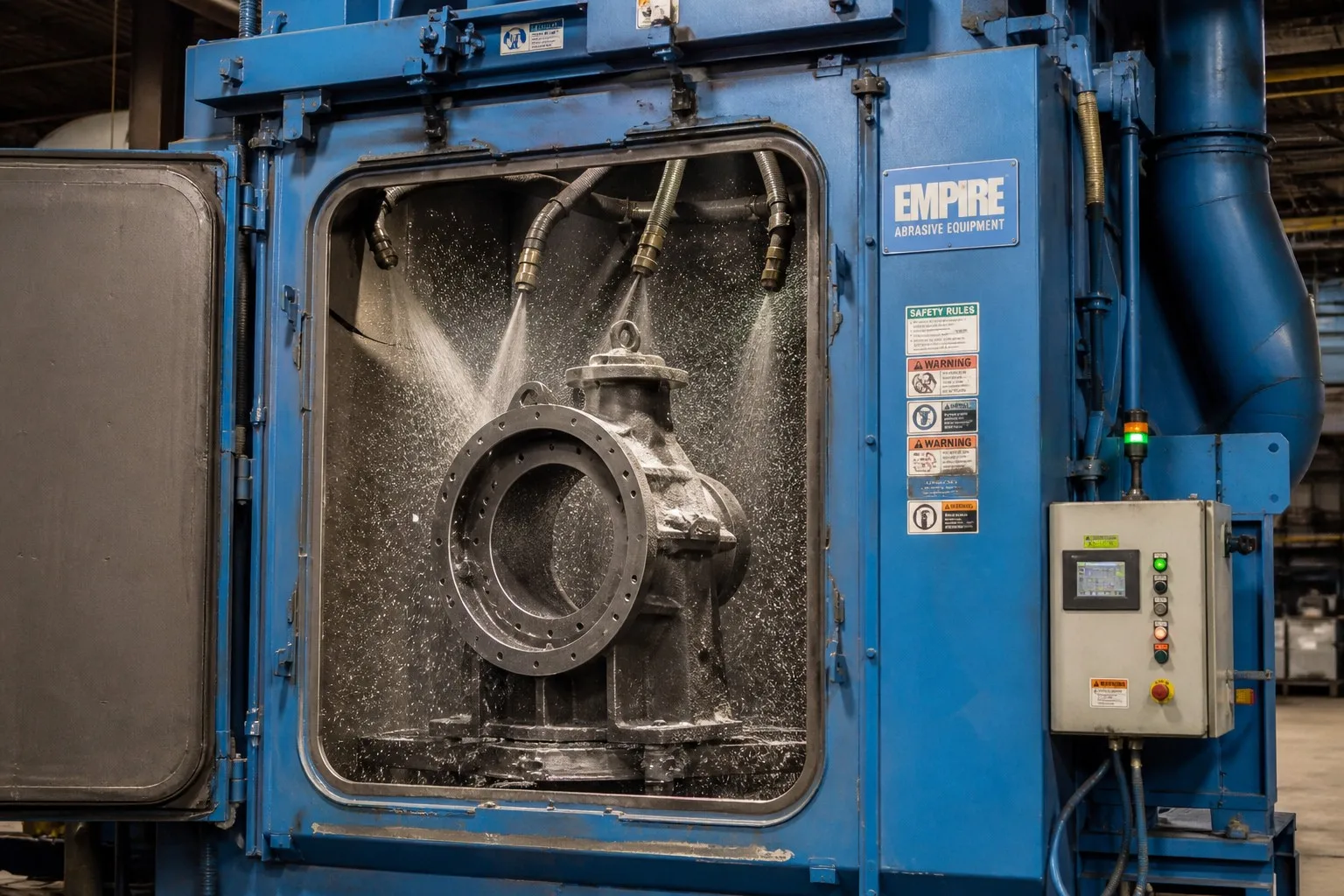
2. Blasting: The Foundation of Surface Preparation
2.1 Shot Blasting vs. Grit Blasting
| Parameter | Shot Blasting | Grit Blasting |
|---|---|---|
| Media | Rounded steel shot | Angular steel/iron grit or abrasive |
| Purpose | Clean, peen, and smooth | Clean and profile (anchor pattern) |
| Surface effect | Compressive stress (peening benefit) | Rougher profile for coating adhesion |
| Typical use | General cleaning, scale removal | Before painting or coating |
2.2 Media Types
| Media | Hardness | Application |
|---|---|---|
| Cast steel shot (S230-S550) | 40-50 HRC | General cleaning of steel and iron |
| Cut wire shot | Uniform | Peening, controlled cleaning |
| Steel grit (G14-G80) | 45-60 HRC | Profile generation for coatings |
| Aluminum oxide | Very hard | Stainless steel (no iron contamination) |
| Glass beads | Soft | Light cleaning, brightening |
| Garnet | Hard | Heavy-duty cleaning |
2.3 Blasting Quality Standards (ISO 8501-1)
| Grade | Description | Typical Use |
|---|---|---|
| Sa 1 | Light blast cleaning | Minimal requirement, light service |
| Sa 2 | Thorough blast cleaning | General industrial painting |
| Sa 2.5 | Very thorough blast cleaning | Recommended for most coating systems |
| Sa 3 | Blast cleaning to visually clean steel | Immersion service, high-performance coatings |
For stainless steel castings, blasting media must be free of iron contamination to avoid surface rust staining; dedicated stainless blasting lines or iron-free media are required.
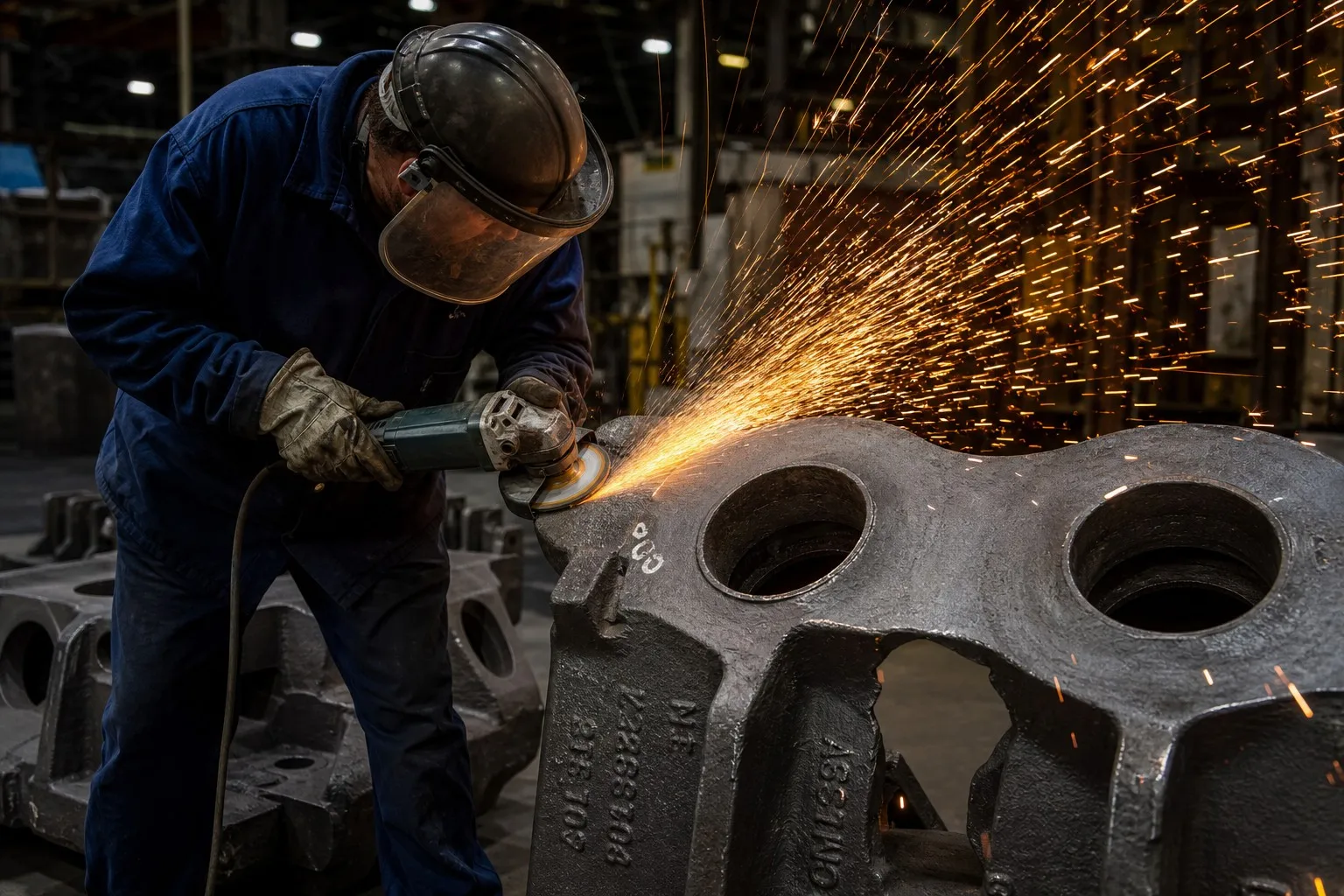
3. Grinding and Fettling
3.1 Operations
| Operation | Purpose | Tooling |
|---|---|---|
| Riser and gate removal | Remove feeding system | Oxy-fuel cutting, plasma, band saw |
| Stub grinding | Flush-remove gate remnants | Angle grinders, snag grinders |
| Defect excavation | Prepare defects for weld repair | Die grinders, gouging |
| Flash removal | Remove mold line flash | Grinders, chisels |
| Final blending | Smooth transitions | Flap discs, belts |
3.2 Grinding Quality Requirements
- Ground surfaces smooth to touch, free of sharp notches
- Riser stubs ground flush to casting surface (typically within 0.5-1 mm)
- No thermal damage (burning) from aggressive grinding
- Surface preparation for weld repair: defect fully excavated, NDT-confirmed clean (e.g., MT or PT check of excavated area)
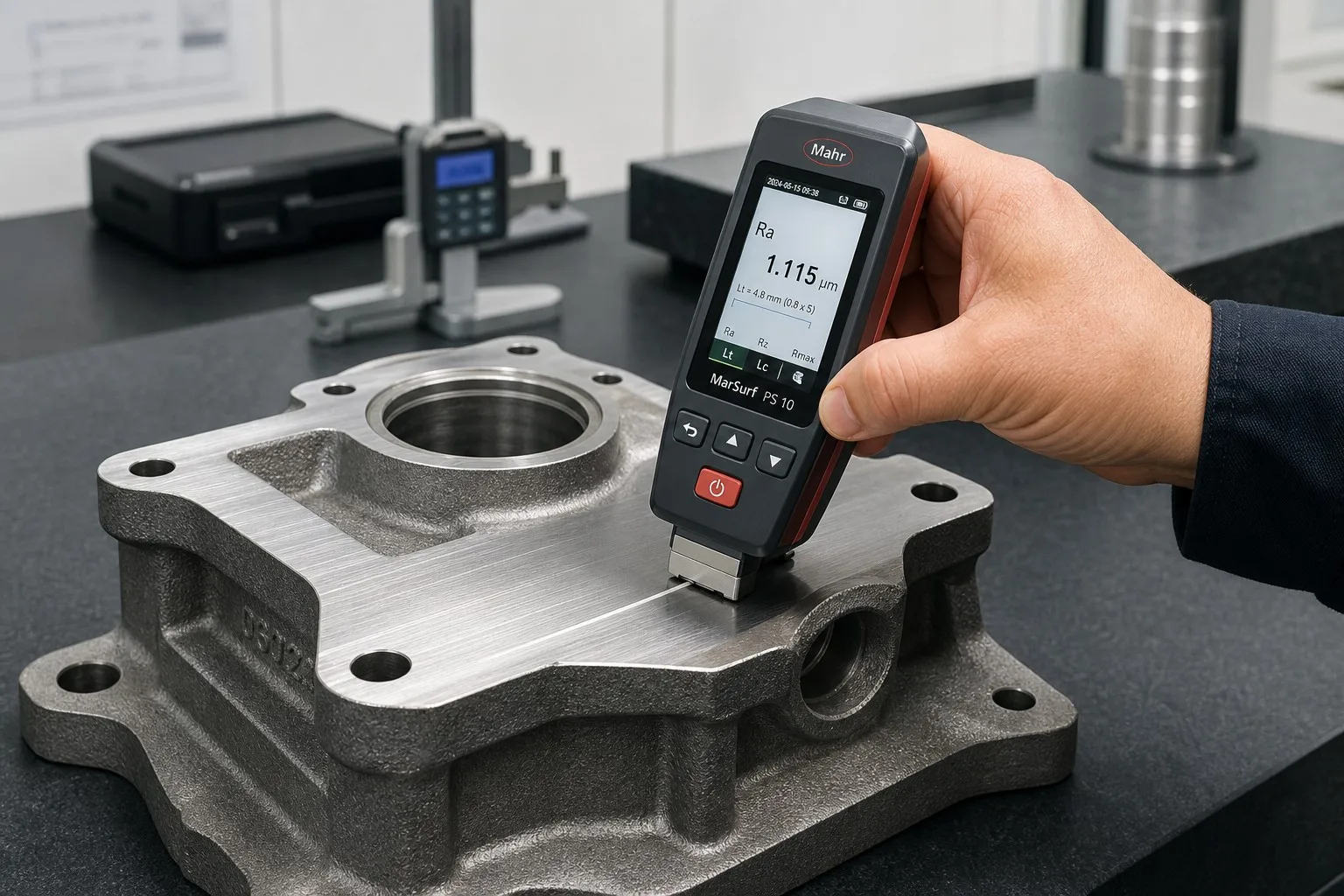
4. Surface Roughness: Measurement and Acceptance
4.1 Measuring Surface Roughness
| Method | Parameter | Application |
|---|---|---|
| Contact profilometer | Ra, Rz, Rmax | Machined and precision surfaces |
| Surface roughness comparator | Visual/tactile comparison | As-cast and blasted surfaces |
| 3D optical profilometry | Sa, Sq, Sz | Research, validation |
4.2 Typical Values
| Surface Condition | Typical Ra |
|---|---|
| As-cast sand casting | 12.5-50 µm |
| Shot blasted | 6.3-25 µm |
| Machined (general) | 1.6-6.3 µm |
| Machined (sealing) | 0.4-3.2 µm |
| Ground | 0.8-3.2 µm |
5. Corrosion Protection Systems
5.1 Selection by Service Environment
| Environment | Recommended System |
|---|---|
| Indoor, dry storage | Rust preventive oil or light coating |
| Outdoor, mild | Primer + enamel (1-2 coats) |
| Outdoor, industrial | Epoxy primer + polyurethane topcoat |
| Marine / immersion | Epoxy systems (2-3 coats), zinc-rich primer |
| Underground / severe | Hot-dip galvanizing or heavy epoxy |
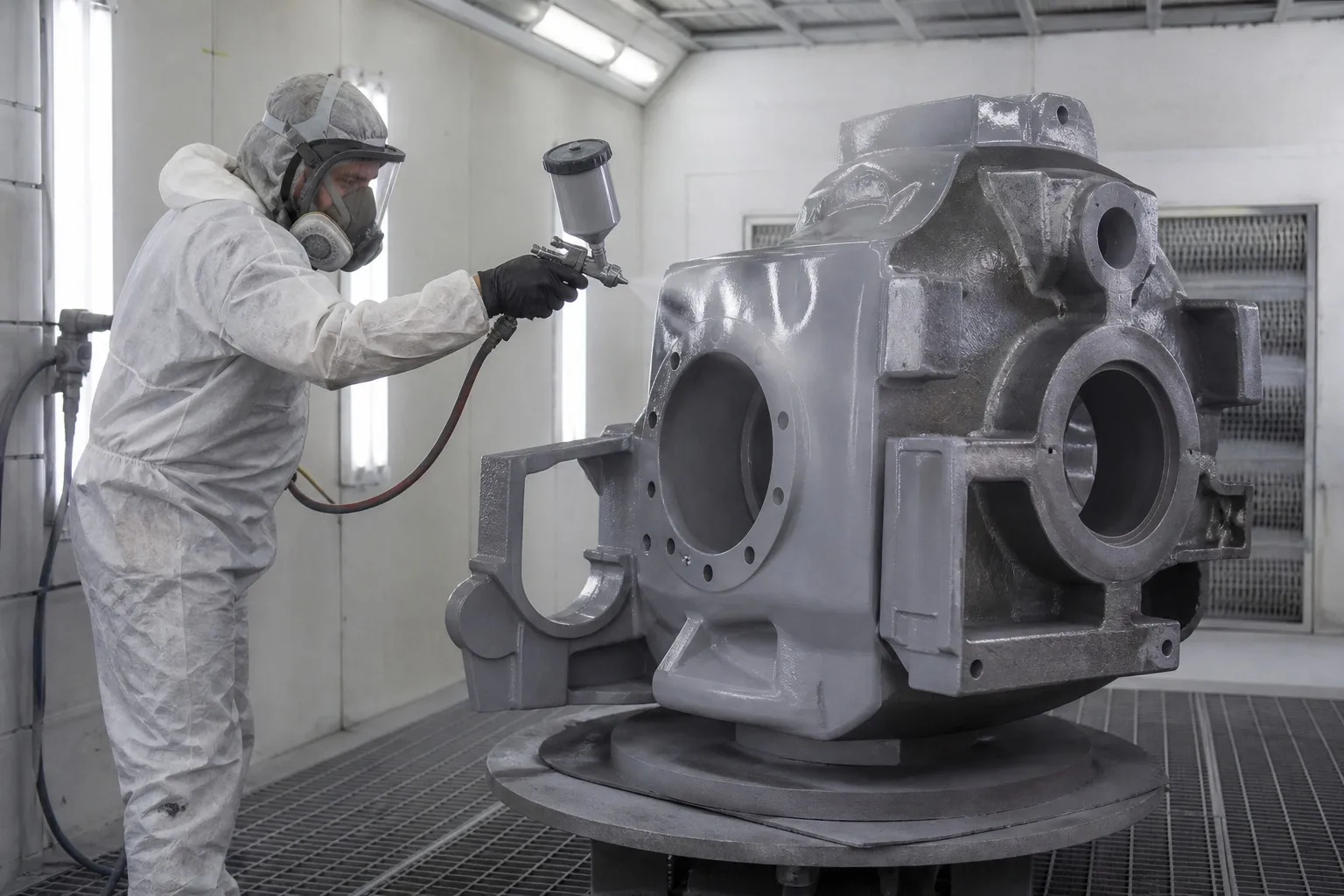
5.2 Painting Systems
| System | DFT (Dry Film Thickness) | Application |
|---|---|---|
| Primer only | 25-50 µm | Temporary protection, machining castings |
| Primer + enamel | 80-120 µm | General industrial equipment |
| Epoxy system | 150-300 µm | Corrosive industrial environments |
| Zinc-rich + epoxy + PU | 250-350 µm | Marine, offshore, bridges |
5.3 Other Protection Methods
| Method | Process | Typical Use |
|---|---|---|
| Hot-dip galvanizing | Zinc dip at 450 °C | Small-mid iron castings, outdoor |
| Electroplating (Zn, Ni, Cr) | Electrolytic deposition | Machined precision parts |
| Powder coating | Electrostatic + oven cure | Decorative and industrial finish |
| Phosphating | Conversion coating | Paint base, friction parts |
| Rust preventive oil (VCI) | Volatile corrosion inhibitor | Export protection, storage |
6. Coating Quality Testing
6.1 Thickness Measurement
- Magnetic gauge (ferrous substrates): dry film thickness per ISO 2808
- Eddy current (non-ferrous): for aluminum and austenitic stainless
- Acceptance: spot-check per ISO 19840 or project specification (e.g., 80-20 rule)
6.2 Adhesion Testing
| Test | Method | Acceptance |
|---|---|---|
| Cross-cut (ISO 2409) | Lattice cut + tape pull | Class 0-1 typically |
| Pull-off (ISO 4624) | Adhesion tester, dolly | ≥ 3-5 MPa typical |
| Bend/impact (flexible systems) | Deformation test | No cracking or delamination |
6.3 Surface Profile Verification
- Replica tape (Testex) per ISO 8503-5: verifies anchor profile depth (typically 40-100 µm for coatings)
7. Export Protection and Packaging
7.1 Rust Prevention for Sea Freight
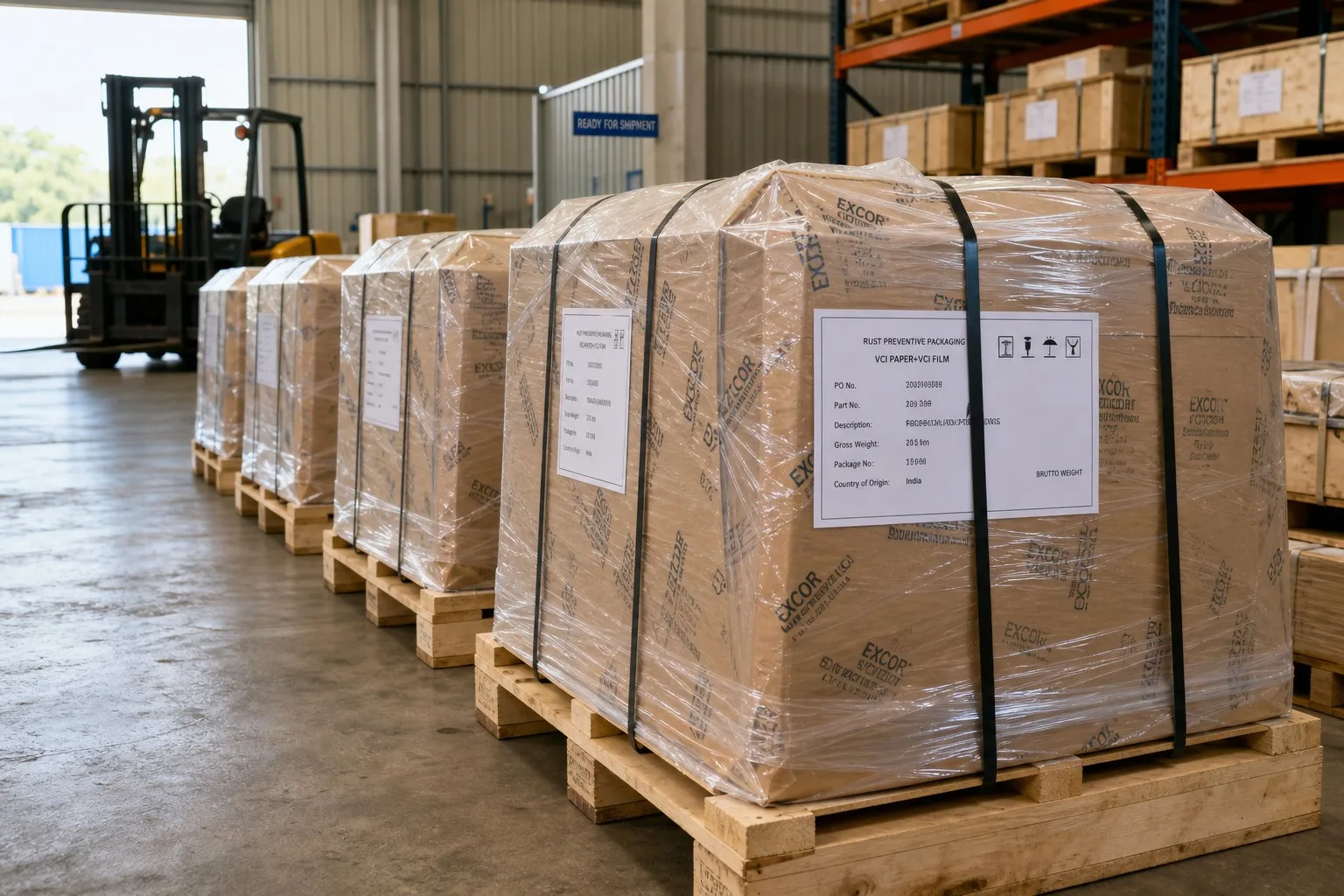
| Protection | Application |
|---|---|
| VCI paper / film | Wrap machined surfaces and complete castings |
| Rust preventive oil | Machined faces, bores |
| Desiccant | Inside sealed packages and containers |
| Silica gel + humidity indicator | Monitors moisture exposure |
7.2 Packaging Requirements
| Item | Requirement |
|---|---|
| Pallet | Fumigated (ISPM 15) for export |
| Securing | Steel banding, corner protectors |
| Machined surface protection | Wooden covers, plastic caps on ports |
| Heavy castings | Blocked and chocked, load-distribution |
| Container loading | Weight distribution per packing plan |
8. Surface Quality Acceptance Criteria
| Check | Typical Acceptance |
|---|---|
| Blast grade | Sa 2.5 minimum for painted castings |
| Visual surface | No scale, sand, sharp edges, or flash |
| Grinding quality | Riser stubs flush, no burns |
| Coating | Uniform, no runs, sags, pinholes, or bare spots |
| DFT | Within specification range |
| Rust on arrival | None on protected surfaces |
9. Surface Finishing in Practice
A complete finishing line for industrial castings typically follows:
- Knockout and riser removal
- Shot blasting (Sa 2.5)
- Grinding and fettling
- Defect inspection and weld repair (if required)
- Second blast (final clean, uniform profile)
- Machining (where specified)
- Rust prevention (oil, VCI) or coating (paint system)
- Dimensional and surface inspection
- Packaging for transport
At Dandong City Pengxin Machinery Co., Ltd., surface finishing is a controlled production stage, not an afterthought. Shot blasting to Sa 2.5, systematic fettling, calibrated coating application, and VCI-protected export packaging are standard practice on every order — with coating thickness and adhesion verified per specification before release.
Conclusion
Surface finishing converts a raw casting into a deliverable component. The discipline spans blast cleaning, grinding, coating chemistry, testing, and packaging — each stage documented and verified. Getting it right protects the part in transit, in storage, and in service for decades.
Dandong City Pengxin Machinery Co., Ltd. has applied this full finishing chain to steel and iron castings since 1958 — for customers in steel mills, mining, energy, and construction equipment worldwide.
Specify your environment and finish requirements — our engineers will recommend the correct blasting grade, coating system, and packaging for your part.
Dandong City Pengxin Machinery Co., Ltd. — Heavy Castings and Precision Machining, Since 1958.
Products
Hot News
Contact Us
- Phone:+86 15941574876
- Fax:0415-7875330
-
Email:jackma@px-casting.com